
Charities and NHS partners
Let's reduce barriers together through practical, evidence-based home adaptation support and inclusive design.
Why healthier spaces matter
The link between homes and health is not opinion. It is evidence.
The places where people live, recover and spend time have a direct and measurable impact on physical and mental health. For people with sensory needs, cognitive conditions, chronic illness and disabilities, the wrong environment does not just cause discomfort. It causes harm. The right environment supports recovery, independence and emotional safety.
The cost of poor housing to the NHS
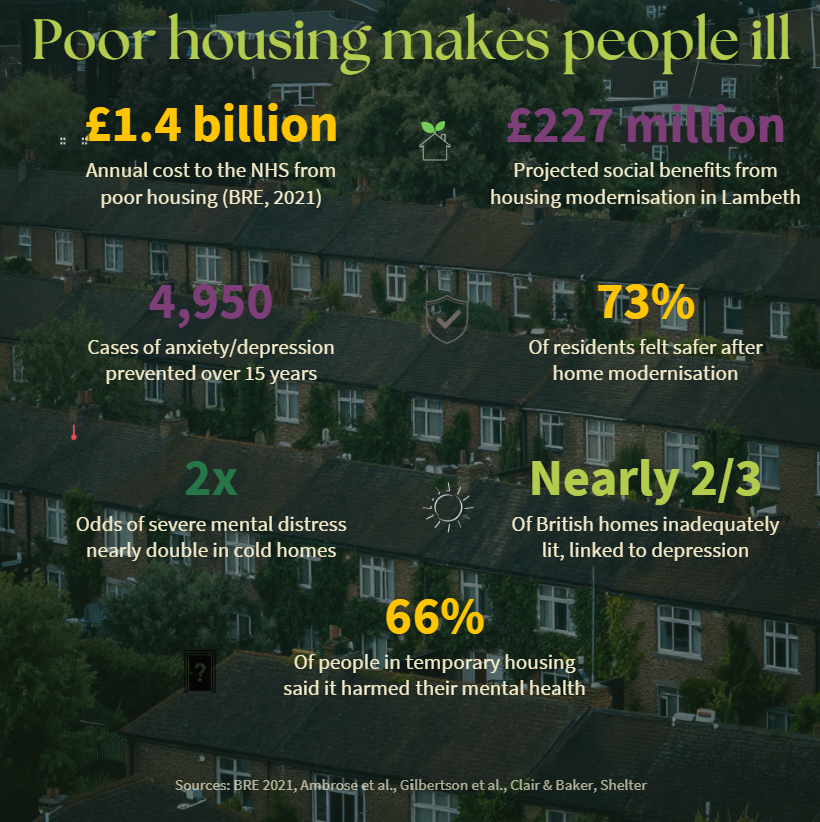
Poor housing costs the NHS an estimated £1.4 billion every year in first year treatment costs alone (BRE, 2021). When you factor in ongoing care, mental health services and social care, the true figure is significantly higher.
The Ambrose et al. report on Lambeth projected total social benefits of £227 million from housing modernisation, driven largely by gains in individual wellbeing and reduced demand on the NHS.
Energy efficiency upgrades alone are estimated to prevent 4,950 cases of anxiety or depression over 15 years by reducing fuel poverty. Security improvements such as new windows and doors are projected to result in 1,330 fewer annual cases of common mental disorders.
What happens when homes are redesigned
Research by Gilbertson et al. in Wakefield found that 73% of residents felt safer and more secure in their homes one to two years after modernisation. Many described a shift from seeing their home as a place to sleep to experiencing it as a haven.
Within two years of home improvements, residents consistently report feeling happier and more in control of their environment.
Sensory environments and cognitive conditions
For autistic people, people with ADHD, dementia, acquired brain injuries and sensory processing differences, the built environment is not neutral. It actively helps or hinders daily life.
Sensory overload from lighting, noise, colour and spatial layout is a leading cause of distress, meltdown and shutdown in neurodivergent people. Poorly designed spaces increase anxiety, reduce the ability to concentrate and make everyday tasks harder than they need to be.
Evidence based design interventions include
- •Adaptive lighting that reduces glare and supports circadian rhythms
- •Acoustic treatments that lower background noise and reverberation
- •Colour palettes chosen for their calming or grounding properties, informed by colour psychology research
- •Spatial layouts that provide clear wayfinding, reduce visual clutter and offer quiet retreat areas
- •Tactile surfaces and materials selected for sensory comfort rather than appearance alone
Nearly two thirds of British homes are inadequately lit (BRE). Poor lighting is linked to Seasonal Affective Disorder and cyclical depression. Having enough daylight halves the risk of feeling a lack of energy.
The impact of cold, damp and insecurity
Research by Clair and Baker shows that moving into a cold home nearly doubles the odds of severe mental distress for people with previously good mental health. For those already at the borderline of distress, the odds of severe mental illness more than triple.
32% of households who reduce fuel use due to cost worries report symptoms of anxiety or depression.
A Shelter survey found that 66% of people in temporary housing said it had a negative impact on their mental health. 57% said it adversely affected their children.
83% of burglary victims are emotionally affected, frequently reporting difficulty sleeping, anxiety and a loss of confidence. Domestic noise and overcrowding are significant sources of stress that prevent emotional regulation.
Health inequalities in SE London
People with learning disabilities and autism in SE London face a 20 year reduced life expectancy. Minority ethnic communities with these conditions have a 12 year shorter lifespan than white counterparts.
Life expectancy remains 6.7 years lower for men and 6.1 years lower for women in the most deprived areas of Greenwich.
Royal Greenwich's social prescribing programme facilitates an average of 200 referrals per month, linking over 5,000 residents per year to community resources. NeuroInclusive Interior Design is a natural extension of this approach, addressing the physical environment as a determinant of health.
Sources
- BRE (2021) The Cost of Poor Housing to the NHS
- Ambrose et al. (2018) Better Housing, Better Health in London Lambeth: The Lambeth Housing Standard Health Impact Assessment and Cost Benefit Analysis
- Clair and Baker, Cold homes and mental health
- Shelter, Temporary accommodation and mental health
- Royal Greenwich Health and Wellbeing Strategy 2023 to 2028
- Royal Greenwich Local Account 2024 to 2025
How the Hackit model works

How you can collaborate with us

Research collaboration
Work with us on research projects and evidence based practice in NeuroInclusive Interior Design.
Research collaboration
Join a working group
Contribute to working groups shaping inclusive design practice and policy.
Join a working group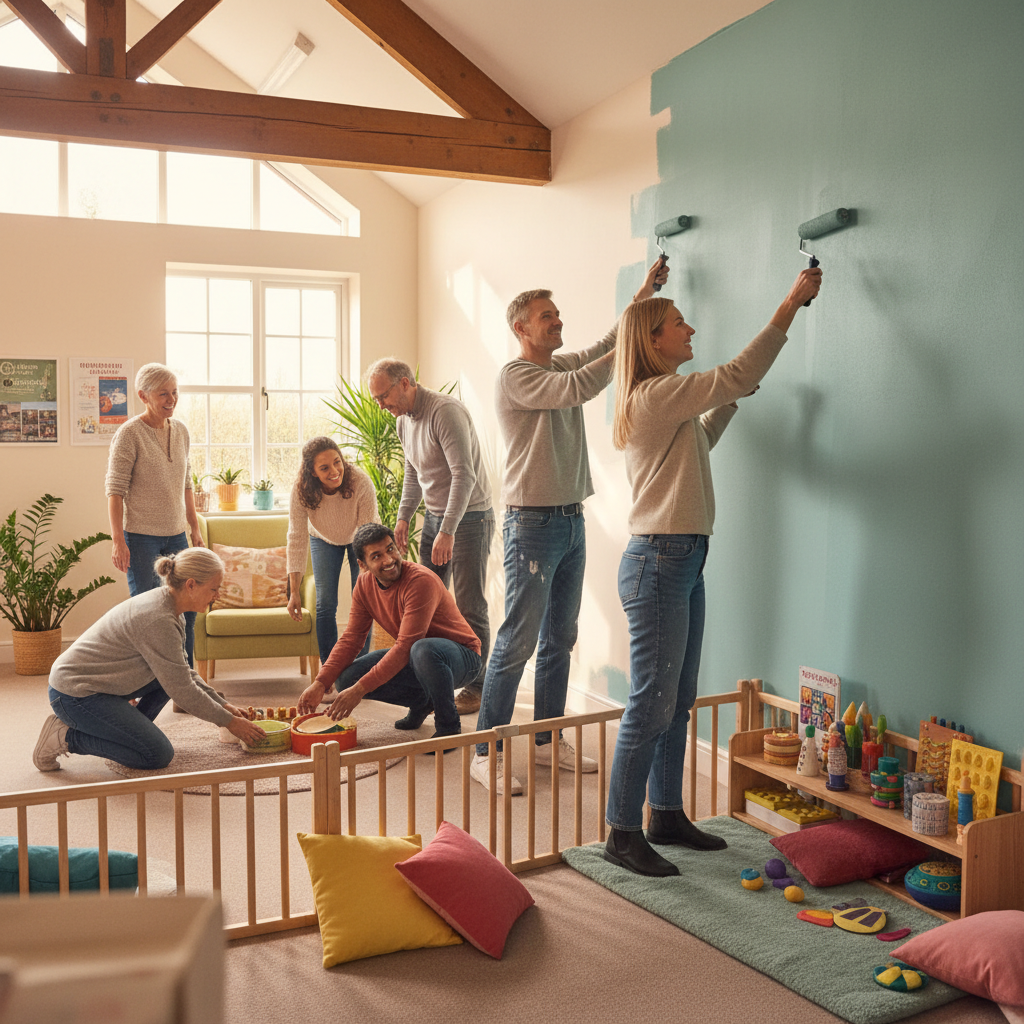
Community volunteering
Volunteer on community projects and events that create real change for real people.
Community volunteering
Referral partnership
Refer service users to Hackit Design for home assessments and inclusive design support.
Referral partnershipSafeguarding and boundaries
We work with people who may be vulnerable. All collaboration relationships are guided by our safeguarding, confidentiality and data protection policies.
Let us work together
Choose how you would like to collaborate and we will follow up within 5 working days.
Sign up to collaborate